A structural engineering consultancy commissioned Phase to carry out long-term monitoring of a busy operational dry dock at a Scottish harbour facility. The requirement was to establish a baseline of structural conditions and monitor for any movement in the dock walls and floor over an extended period — providing objective, repeatable evidence of structural behaviour to support ongoing operational and assurance decisions.
The dry dock is in active use. Surveys could only be carried out when the dock was emptied of water and no vessel was present — ensuring exact like-for-like conditions on every visit and maintaining the integrity of the monitoring dataset across the full programme.
What Phase Established
Phase installed brass monitoring studs in the dock floor concrete and prism nests on the dock walls. A baseline survey was carried out establishing the precise position and elevation of every monitoring point, tied into external survey control positioned outside the monitoring area.
Three survey types were applied across the programme: precision total station monitoring of wall bracket points detecting horizontal and vertical movement; precision digital levelling of floor brass studs detecting settlement or heave; and annual laser scanning providing wider area capture beyond the specific monitored points. External survey control was brought in fresh on every visit to eliminate accumulated error and maintain dataset integrity.
The Consequence Addressed
An operational dry dock carrying vessels requires confidence that the structure is behaving within acceptable parameters. Undetected movement in the walls or floor carries safety, operational, and insurance consequences. Three years of objective, repeatable monitoring — carried out under consistent conditions — provides the defensible evidence base needed to confirm structural behaviour or identify emerging issues before they become critical.
The Monitoring Programme
Wall Bracket Monitoring
Precision total station observations carried out on wall mounting points using prisms in centering brackets. The same dedicated monitoring total station — 1 second angular accuracy — was used on every visit, eliminating instrument variation and maintaining dataset consistency across the full programme. Survey tied into external Phase control on each visit. Coordinates calculated and compared against baseline on return to office — providing a repeatable, defensible record of wall behaviour over time.
Floor Levelling Survey
Precision digital levelling carried out on brass studs installed in the dock floor concrete. The same dedicated digital level and invar staff — reserved exclusively for this monitoring programme and not used for other work — were used on every visit, eliminating instrument variation and maintaining dataset consistency. Elevations tied into external Phase control on each visit. Results compared against baseline elevations — detecting any settlement or heave in the dock floor across the monitoring period.
Annual Laser Scanning
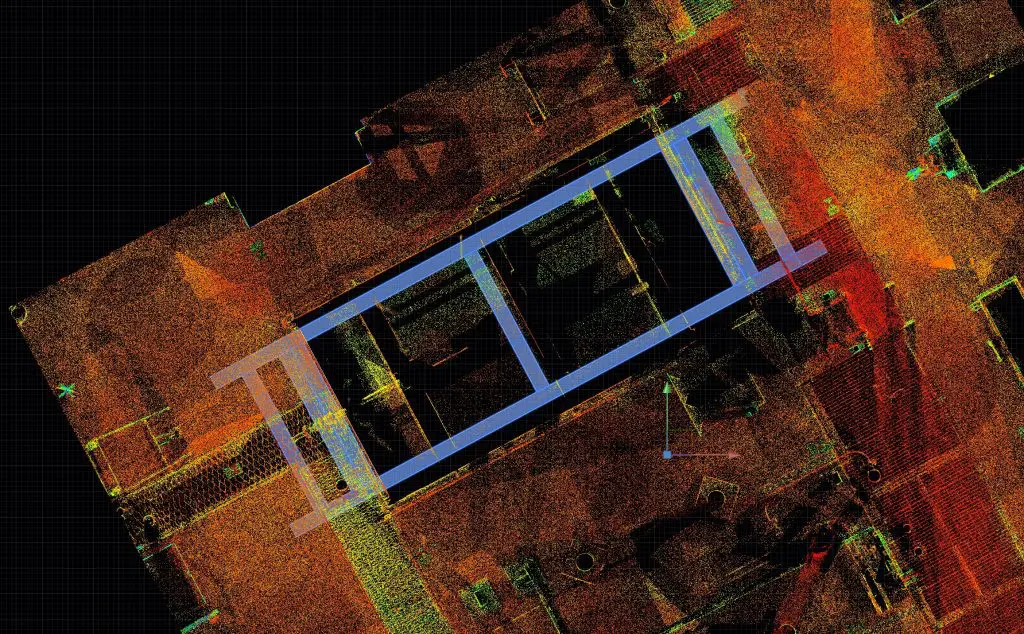
Laser scanning carried out annually to provide wider area capture beyond the specific monitored points — identifying any surface deterioration, cracking, or condition change that point monitoring alone would not detect. Each scan tied into site control and compared against the previous year’s dataset.
Baseline Established
Wall brackets and floor brass studs installed. External survey control established outside the monitoring area. Baseline coordinates and elevations recorded for all monitoring points.
Operational Constraints Managed
All surveys carried out when the dock was emptied of water and free of vessels — ensuring exact like-for-like conditions on every visit and maintaining dataset integrity across the full programme.
Repeat Monitoring Carried Out
Wall and floor surveys carried out initially every three months. External control brought in fresh on each visit. Same dedicated instruments used throughout. Results compared against baseline and previous readings on return to office.
No Significant Movement Detected
Monitoring data consistently showed no significant movement in walls or floor. On the basis of this evidence, survey frequency was reduced — a decision supported by the objective record Phase had established.
Annual Laser Scanning
Wider area laser scanning carried out annually — providing a complementary layer of condition verification beyond the specific monitored points.
Defensible Record Maintained
Every visit producing a monitoring report. Every reading compared against baseline. Three years of objective, repeatable evidence of structural behaviour — available for operational, insurance, and assurance purposes.
Related Work
Our Experience
The programme in numbers
Monitoring Programme
3
Years
Survey Types Applied
3
Wall, Floor & Laser
Significant Movement
0
Detected
Why It Mattered
An operational dry dock is not a structure that can be taken out of service for investigation. Long-term monitoring provides the only reliable way to establish whether the structure is behaving acceptably — and to detect any emerging issues before they become operational or safety concerns. Phase provided that evidence, consistently and repeatably, over a three-year period.
Monitoring That Responded To Evidence
The initial survey frequency of every three months was reduced on the basis of the monitoring data itself — no significant movement detected across multiple visits. That’s monitoring working exactly as it should. Phase continued to provide the evidence base that supported those decisions throughout the programme.
Consistent Conditions, Consistent Data
Every survey carried out under the same conditions — dock emptied, no vessel present, external control brought in fresh. The same dedicated instruments used on every visit — a 1 second monitoring total station for wall points and a dedicated digital level with invar staff for floor levelling, neither used for any other work. The consistency of the approach is what makes the dataset defensible. When the data shows no movement, that conclusion stands up to scrutiny because the methodology behind it is rigorous.
The Result
Three years of structural monitoring. No significant movement detected. Survey frequency reduced on the basis of evidence. A defensible record of structural behaviour available for operational, insurance, and assurance purposes.
Structural concern that needs objective evidence
If structural condition or movement needs to be monitored over time — whether for operational assurance, insurance requirements, or engineering decisions — a short conversation is often enough to establish whether Phase can help.